
What Does a Restaurant Accountant Actually Do? (And Why Your Bookkeeper Isn’t One)

If you've ever handed your bookkeeper a stack of invoices and a POS export and hoped for the best, you already know the uncomfortable truth: bookkeeping and restaurant accounting are not the same job. One keeps the lights on. The other tells you whether you should be worried about the lights at all.
Most operators find this out the hard way — usually around the time a lender asks for financials that don't add up, a partner questions where the margin went, or tax season turns into a scramble to reconstruct a year that should have already been understood in real time.
The Bookkeeper's Job, and Where It Stops
A bookkeeper's role is essential but narrow: record transactions, reconcile accounts, categorize expenses, keep the books from turning into chaos. That's data entry with a system behind it. It answers the question "what happened?"
What it doesn't answer is "what does it mean, and what should we do next?" That's a different discipline entirely — and it's where most restaurant groups quietly fall short without realizing it.
What a Real Restaurant Accountant Does
A restaurant accountant — the kind with actual hospitality experience, not a generalist working from a template — understands the specific mechanics of this industry: prime cost, theoretical vs. actual food cost, labor as a percentage of sales by daypart, multi-unit consolidation, tip credit compliance, and the seasonality that makes a single month meaningless without context.
That means:
Financials that are accurate, not just balanced. A P&L can technically reconcile and still be useless if costs are miscategorized or COGS is distorted by inventory timing.
Timeliness that makes the numbers actionable. Financials that arrive weeks late describe a restaurant that no longer exists. By the time you see the problem, you've already lived through another month of it.
Forecasting built on real data. You can't project cash flow, plan a new location, or negotiate with a lender using numbers you don't trust.
Advisory that goes beyond compliance. Filing taxes and closing books is table stakes. The real value is a partner who tells you what your numbers mean for your next lease, your next hire, or your next menu price change.
Garbage In, Garbage Out
Here's the part most operators don't want to hear: bad financials aren't just inconvenient — they're actively dangerous. If your prime cost is miscalculated, every staffing decision built on top of it is wrong. If your P&L doesn't reflect true food cost, every pricing decision is a guess. Forecasting on flawed historical data doesn't produce a flawed forecast — it produces false confidence, which is worse.
Ask yourself honestly: Do you fully understand your P&L, line by line? Are your financials in your hands within days of month-end, not weeks? Would you bet a bank loan on the accuracy of what you're looking at right now?
If the answer to any of those is "not really," you don't have an accounting problem. You have a foundation problem — and everything else you build on top of it inherits the crack.
Why "Outsourced" Isn't a Commodity
Not all outsourced accounting is created equal, either. A generalist firm that happens to take restaurant clients will apply the same chart of accounts and the same cadence they use for a dentist's office or a law firm — because that's the only playbook they have. The result looks like accounting, but it doesn't speak restaurant.
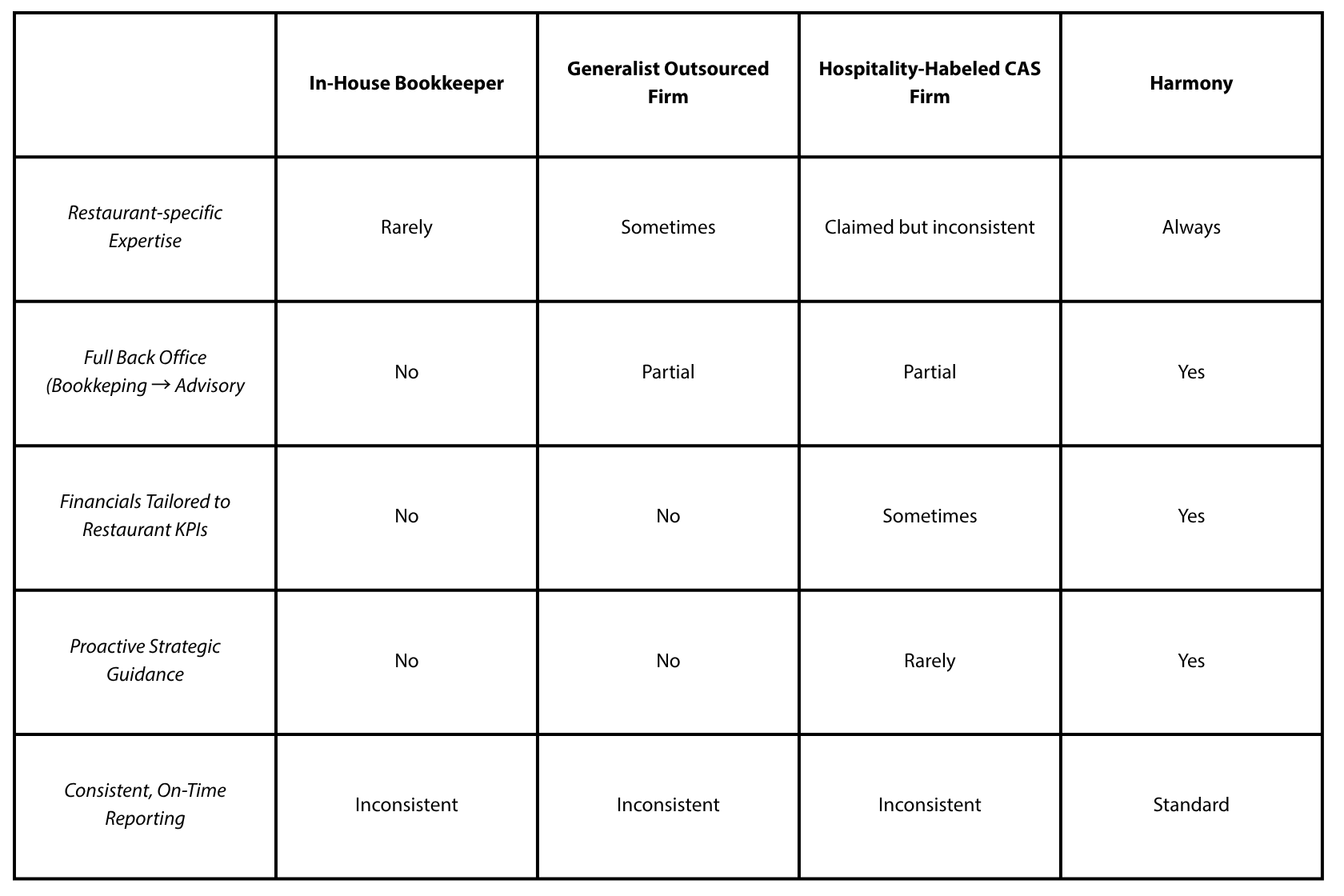
Harmony's model is different because it was never generalist to begin with. We built our entire back office — from bookkeeping through controller-level oversight to CFO-level advisory — specifically around how restaurants actually operate: tight margins, thin cash cushions, labor volatility, and razor-thin timelines between insight and action. And unlike firms that route your books through a rotating cast of overseas contractors, Harmony's team is 100% American and fully in-sourced — the same trained professionals working your account month after month, held to one standard, accountable to you directly.
Even among firms that market themselves as hospitality-focused, few actually operate at this level. Plenty of outsourced CAS providers will put "restaurant" or "hospitality" in their marketing without the depth of specialization, consistency, or accountability behind it — a template chart of accounts with a restaurant label on it isn't the same as a team that lives in prime cost and labor percentages every day. That gap is exactly where Harmony's standards and guarantees are built to hold up.
That's the difference between an in-house bookkeeper, a non-specialized outsourced firm, and Harmony:
Peerless Financials, Paired With Advice That Matters
Accurate, on-time financials are the floor, not the ceiling. What actually moves a restaurant business forward is what happens after the numbers are right: a CFO-level conversation about whether that third location pencils out, a proactive flag on a margin slide before it becomes a crisis, a benchmark against how similar operators in your market are actually performing.
That's the model Harmony was built to deliver — financials you can trust completely, an in-sourced American team that stands behind every number, and advisory guidance that turns those financials into decisions.
If you're not sure your current setup can say the same, let's talk. A quick conversation with our team can tell you exactly where your books stand — and what a firm that actually meets the standards it claims looks like.